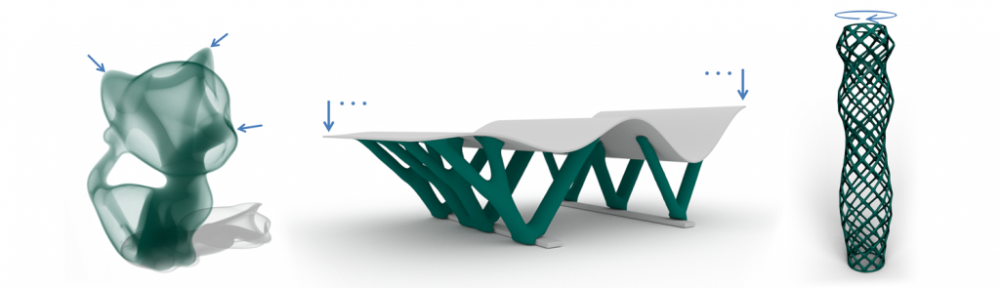
Topology optimization (TO) is widely recognized as an important design method for exploiting the full potential of additive manufacturing (AM). It automatically explores a large design space, and aims at finding the structure or component that is optimal for the relevant design specifications. Without applying manufacturing constraints in TO, it generates optimized digital components that are very complex in geometry, and thus are difficult, if possible, to produce by conventional manufacturing. Integrating conventional manufacturing constraints would limit the performance of the optimized components. On this aspect, the capability of AM to fabricate complex geometries provides an opportunity to realize the optimized components from TO, as AM possesses far fewer constraints than conventional manufacturing. Nevertheless, specific AM characteristics and constraints shall be integrated in TO to facilitate production and reduce post-processing of topology optimized components. Following the philosophy of Design for Manufacturing (DfM), this has resulted in the new field of Topology Optimization for AM (TOfAM).
Much progress has been made in the past few years on this integration, from geometric constraints such as the overhang angle to typical AM features such as infill, to process simulation with the involved physics.
The objective of this course is to provide an overview of, and stimulate research in topology optimization for additive manufacturing (TOfAM) by sharing and discussing recent developments. In addition to lectures, this course also includes an interactive session where participants can get acquainted with relevant TOfAM procedures using shared source code in Matlab with immediate assistance.
Please note: for the hands-on session, a basic knowledge of the Matlab code for classical TO is assumed. For those less familiar with TO, the following paper is recommended to prepare for this course: Sigmund, O. A 99 line topology optimization code written in Matlab. Struct Multidisc Optim 21, 120–127 (2001). https://doi.org/10.1007/s001580050176
Participants are expected to bring their own laptops with Matlab installed.
** The course will only take place with 10 or more participants. **